
Polypharmacy – PROJECT CLOSED
Please note this project has now completed. The information on this page was accurate on closure of the project but will not be updated further. If you have any questions please contact opportunities@healthinnovationwm.org
About the programme
As part of the National Health Innovation Network Polypharmacy Programme: Health Innovation West Midlands (HIWM) supported health care professionals to identify patients at potential risk of harm from problematic polypharmacy and supported better conversations about medicines. HIWM’s local delivery of the programme ran from 2022 to 2025 benefitting patients across the region.
Health Innovation Network Polypharmacy Programme – Local Training & Delivery Evaluation Report
The delivery team at HIWM have developed an extensive evaluation which analyses the impact the local training aspect of the programme has had on clinicians and how it enabled them to build confidence in deprescribing, undertaking Structured Medication Reviews (SMRs) and incorporating Shared Decision Making (SDM).
What problem did the programme look to address?
We dispense over one billion prescription items per year in primary care in England.
Polypharmacy simply means many medicines. As more people live longer with multiple long-term conditions, the number of medicines they take increases. This can have a significant burden on the person managing and trying to adhere to multiple medicines regimes and can also be harmful.
Studies have shown that that over 50% of older people are prescribed a medicine with more harm than benefit, leading to avoidable morbidity, hospitalisation and mortality. In England, in February 2022, there were 876,317 people on 10 or more medicines and 349,653 were 75 or over. A person taking 10 or more medicines is 300% more likely to be admitted to hospital. Polypharmacy adds preventable costs to the healthcare system and diminishes quality of care for the patient. The most deprived areas tend to have the most issues around polypharmacy, also making this a health inequality issue.
Most of the harm from polypharmacy is preventable.
Strategy
The programme supported the routine use of NHSBSA Polypharmacy Prescribing Comparators through national webinars, education, and training—enabling healthcare professionals to identify and prioritise patients for SMRs. Evidence-based Polypharmacy Action Learning Sets (ALS) were rolled out nationwide to equip GPs, pharmacists, and other prescribing professionals with the skills and confidence to safely review and discontinue inappropriate medications.
In partnership with patients, the public, and academic experts, the HIN have also co-designed and evaluated public-facing resources to shift perceptions around prescription medicines, encouraging patients to speak openly about their concerns and expectations regarding medication.
The programme was delivered via the unique 3-Pillar approach. This strategy was designed to holistically target the whole medicine review process from start to end. The key pillars of the programme to deliver the most impact at primary care level:
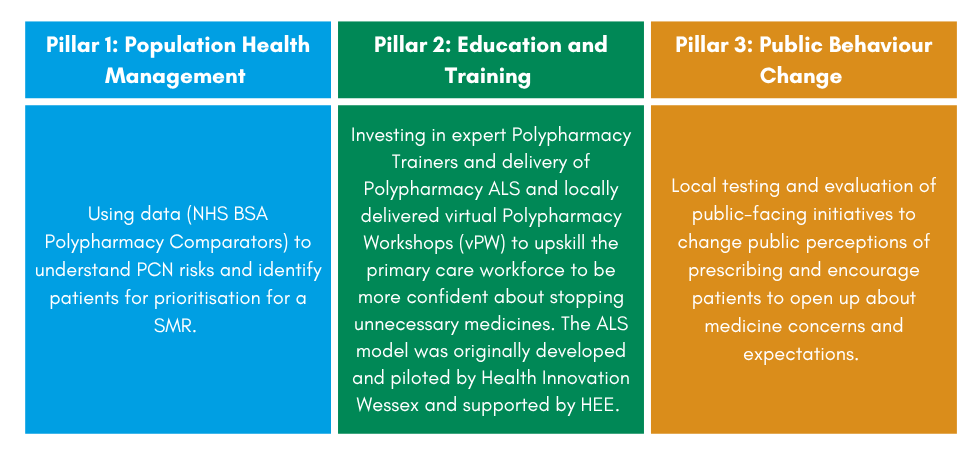
The National Polypharmacy Programme 3-Pillar Approach detailed
Local Delivery
Aligned to the 3-pillar approach, HIWM undertook the following activities as apart of its local delivery.
Pillar 1 – Bespoke Data Packs for Healthcare Professionals undertaking SMRs
In collaboration with the East Midlands Analytics and Evaluation Service, a West Midlands-wide dashboard was developed covering all practices and PCNs across six ICBs. This enabled the creation of tailored data packs for each practice, highlighting 25 key indicators broken down by patient age group to identify high-risk populations. Equivalent to running 25 ePACT2 searches, the packs saved time, reduced manual work, and supported Pillar 1 by helping practices target at-risk groups—content later reinforced through vPW sessions under Pillar 2.
Pillar 2 – Virtual Polypharmacy Workshops and Community of Practice
Between September 2023 and March 2025, 171 clinicians participated in bespoke Polypharmacy Virtual Workshops (vPW) developed by HIWM and led by accredited educators. Across three interactive sessions, participants improved confidence in structured medication reviews, deprescribing, and quality improvement. Complementing this, HIWM established a regional Polypharmacy Community of Practice (CoP), connecting professionals across sectors and ICBs. Through nine lunchtime sessions and a 300-member network, the CoP shared insights on deprescribing, multidisciplinary teamwork, and shared decision-making.
Pillar 3 – Cascading National Patient-Facing Materials
As part of Pillar 3, HIWM tested and refined national patient-facing resources through local focus groups, contributing to the "Resources to Support Patients Having a Structured Medication Review" toolkit. These materials were promoted to over 300 stakeholders and embedded into local training.
Outcomes
(Figures were gathered from feedback and interactive polls conducted during the training sessions, then collated and analysed to present the findings.)
- Links established with Medicines Optimisation teams across the region to establish and promote training programmes offered as a part of the programme.
- 90 Hours of training delivered to delegates across all 6 West Midlands ICBs.
- 89% of participants agreed that the workshops improved their understanding of using data-driven risk stratification to identify patients most in need of an SMR. Over 90% also reported increased confidence in recognising patients at greatest risk of harm from problematic polypharmacy.
- At the start, 48% of delegates rated their confidence at 6 or above on a 10-point scale, rising to 82% by the end of the sessions. Marking a significant increase in self-reported confidence.
- 90% of respondents plan to use a least one of the materials from the NHS 'Resources to Support Patients Having a Structured Medication Review' patient pack) and 62% plan to use two or more.
- HIWM ran 9 Community of Practice sessions from 2022 to 2025, with a mailing list of around 300 members. Held as 1-hour lunchtime events, the sessions featured guest speakers from clinical and academic backgrounds.
Core20 Local Project
In July 2024 the National Polypharmacy Programme issued a funding call looking to award £1,500 to 10 PCNs in the most deprived areas of the UK. Following this funding call the West Midlands had an overwhelming response from local Primary Care Networks (PCN) with 30+ applying for the funding.
With some of the applications being of excellent quality and within highly deprived areas the local Polypharmacy delivery team at HIWM decided to fund an additional four applications. The team selected those who shared detail on their local population, such as patients on 10+ meds and their age groups, and patients who do not speak English as their first language. Additionally, assessing the detail they provided as to how they would conduct their QI project. Furthermore, the team also checked the IMD scores within each of the applicants' practices to determine the shortlist.
To learn more about the project and its outcomes click here to view the poster.
Case Studies
Throughout the project stakeholders have had the opportunity to develop case studies showcasing the impact their work has had on front line practice. Below is a list of case studies developed by key stakeholders and HIWM colleagues:
- Addressing Problematic Polypharmacy In the West Midlands – A Case Study showcasing Health Innovation West Midlands local delivery of the HIN National Polypharmacy Programme.
- Accelerating Safer Prescribing through Polypharmacy Training & Facilitation by Sarah Baig
- Polypharmacy – a pharmacist-led medication review clinic (Solihull Rural PCN)
- Impact of DAMN drugs reviews in Dudley (Dudley ICB)
- Impact of an EMIS search to prioritise care home residents for a pharmacist-led medication review (Coventry and Warwickshire ICB)
- Methotrexate and renal impairment
- Catch me before I fall…
- Improving the care of patients receiving combined antiplatelet and warfarin therapy
- Evaluation of the deprescribing of anticholinergic medications in dementia patients (Dudley Integrated Health and Care NHS Trust)
- Reducing Anticholinergic Burden by conducting Structured Medication Reviews
Testimonials
Below are selected testimonials from practicing healthcare professionals who participated in the programme, reflecting its impact on their practice and professional development:
Sustainability
The impact of the programme has spread across the region with many healthcare professionals getting involved with the programme's offerings and continue to practice the learnings to benefit patients who at risk from problematic polypharmacy. Despite the programme coming to an end HIWM established key links with local universities to enable them to utilise our locally developed materials in Undergraduate and Prescribing courses, thus ensuring the workforce of the future are equipped with the skills necessary to support problematic polypharmacy. The virtual Polypharmacy Workshop content has also been shared with a local ICB medicines optimisation team who intend to continue to deliver this important training within their system.
Additionally, the cross sector Polypharmacy Community of Practice is also continuing with a new host in the region, please reach out to the team via details below to find out more.
Find out more
If you are interested in learning more about the Polypharmacy Programme, want to discuss gaining access to the virtual Polypharmacy Workshop content for local delivery, or wish to know of similar programmes please email Sabeel.sajid@healthinnovationwm.org or Jordan.Leith@healthinnovationwm.org